Introduction: confronting latency in a multi-cloud world
For modern SaaS platforms, performance isn’t a luxury - it’s a baseline expectation. Applications now stretch across public clouds, private data centers, and edge locations, orchestrated to deliver consistent user experience regardless of geography. Yet multi-cloud deployments introduce routing challenges: every provider has its own backbone, peering relationships, and regional bottlenecks. A strategic approach to cloud routing optimization reduces latency, improves uptime, and makes traffic engineering an integral part of product reliability. This article outlines a practical, evidence‑based playbook for multi-cloud traffic engineering that blends anycast routing, BGP optimization, and DNS failover into a coherent, repeatable workflow.
Why multi-cloud routing demands a different playbook
Cloud environments (AWS, Google Cloud, Azure) deliver vast scale, but also immense heterogeneity. Even when you deploy a service identically across providers, network performance can diverge by region, ASN, and last‑mile ISP. The right routing approach must account for: 1) geographic dispersion of end users, 2) provider-specific routing policies, and 3) reliability under network disruption. Modern routing technologies offer two classes of resilience: network-layer strategies (BGP-based decisions and anycast reachability) and application-layer strategies (health checks, DNS-based failover, and traffic steering). For readers who want to connect the dots between these layers, AWS Global Accelerator and related edge-routing practices illustrate how global routing can materially impact latency and failover behavior. Learn more about AWS Global Accelerator. Evidence-based takeaway: a holistic routing strategy should combine edge-forwarding intelligence with robust DNS and transport-layer control.
Core concept: anycast routing as the gateway to lower latency
Anycast routing offers a foundational technique to shorten the path between users and services by advertising a single IP address from multiple locations. The network then routes requests to the nearest or best-performing instance, as determined by its internal topology and policies. In practice, anycast is widely used by CDNs and DNS providers to minimize response times and to improve resilience against localized failures. For example, Cloudflare’s architecture demonstrates how anycast IPs can direct traffic to the closest data center, effectively reducing latency for far-flung users. What is Anycast DNS? and related Cloudflare materials describe how edge routing leverages proximity and network health to steer traffic. These principles translate well to multi-cloud traffic engineering where the same IP is reachable from many locations, but the best route changes with conditions. Operational cue: design your ingress to leverage anycast at the edge while leaving room for provider-specific routing adjustments at the core.
BGP optimization: steering traffic with precision across clouds
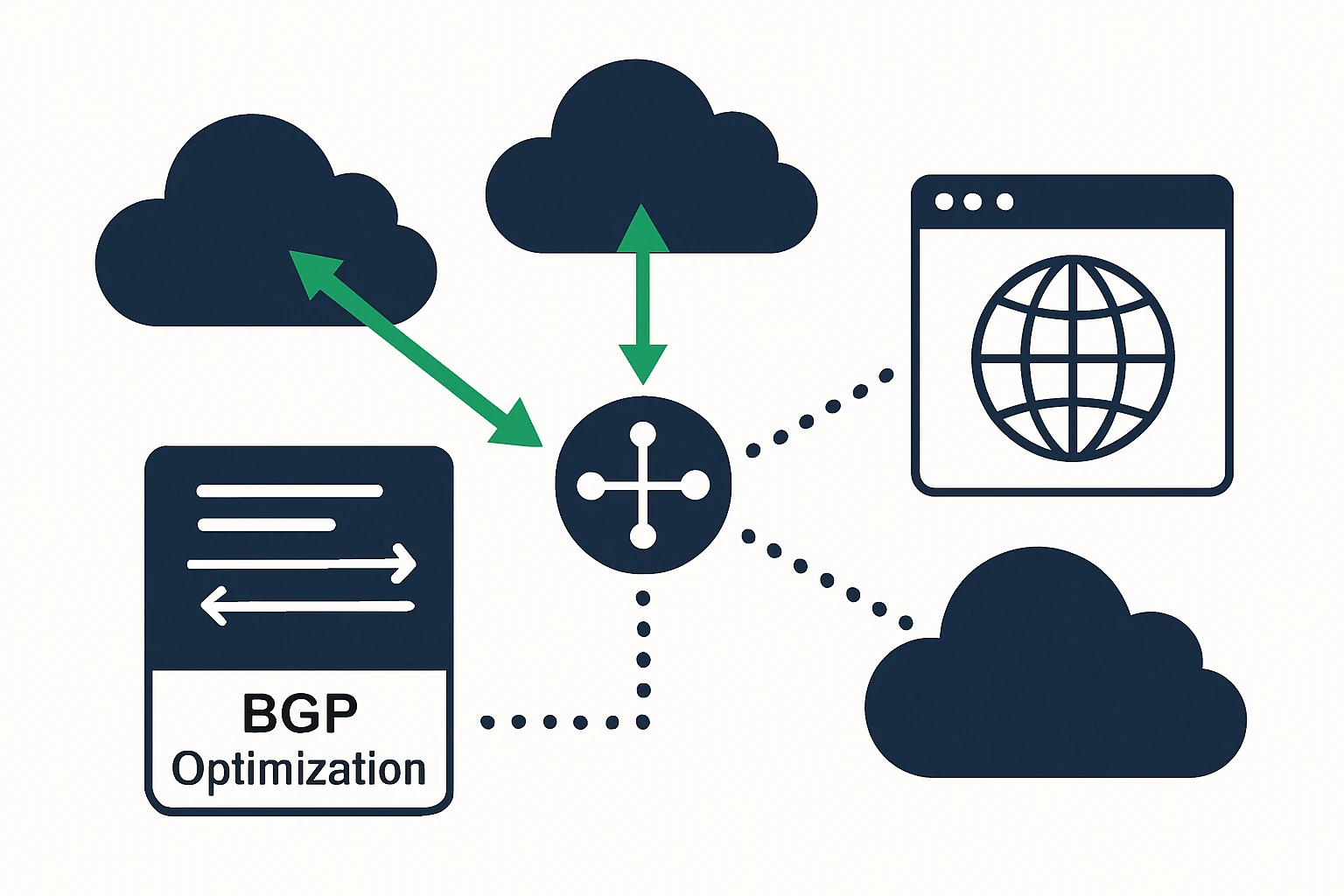
Border Gateway Protocol (BGP) remains the backbone of inter-domain routing, but its default behavior isn’t always aligned with latency or application performance goals in a multi-cloud topology. Inbound optimization - choosing which upstream path most effectively reaches your prefixes - and outbound tuning - how you announce routes to downstream networks - are actionable levers. Cisco’s PfR (Performance Routing) framework highlights practical techniques for improving inbound route selection, including careful manipulation of path preferences, and, when appropriate, selective prepend strategies to influence partner networks. BGP inbound optimization best practices. In a multi-cloud setting, these adjustments must be coordinated with your cloud providers’ edge services to avoid counterproductive oscillations. The core idea is to align BGP policy with real-time latency signals, not just static peering quality. - Trade-off: aggressive inbound optimization can improve latency for some users while worsening it for others if routes change too frequently or unpredictably. - Practical tip: pair BGP policy with robust health checks and a controlled change window to prevent routing churn from causing short-term instability.
DNS failover as a companion to network-layer resilience
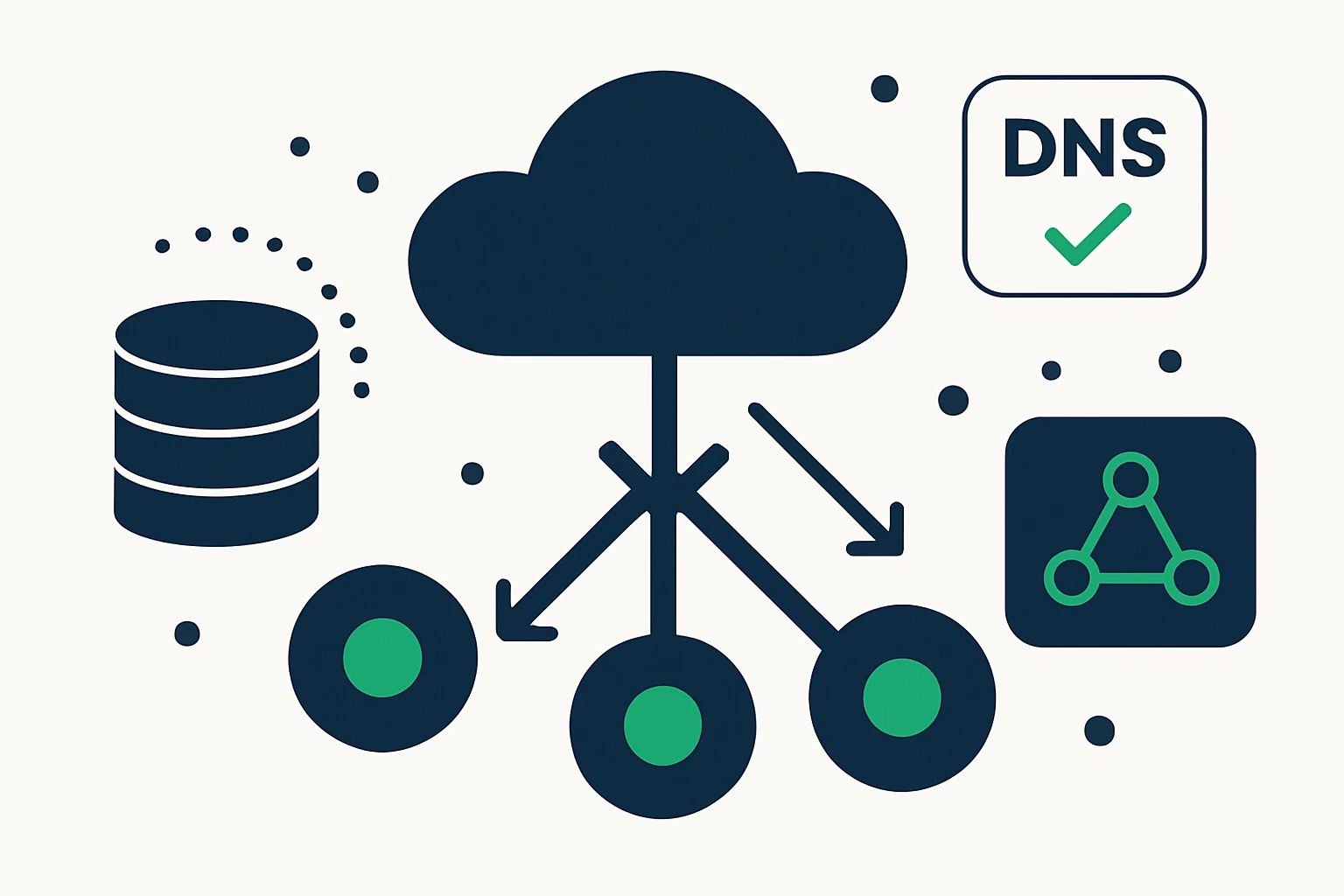
DNS failover is a critical defense-in-depth mechanism for uptime. DNS-based strategies can complement BGP by re-routing end-user traffic at the domain level when an endpoint becomes unhealthy or congested. However, DNS failover should not stand alone, it works best when paired with network-layer health checks and, where possible, finite TTLs that enable faster redirection without sacrificing cache efficiency. Real-world guidance from industry practitioners emphasizes the importance of combining DNS failover with network-layer rerouting to reduce the time to recovery after an outage. DNS failover best practices and real-world data. The messenger here is that DNS resilience is most effective when aligned with end-to-end monitoring and with routing strategies that can adapt to rapid changes in network health. Cloud-based DNS providers often support automated health checks, making it feasible to trigger DNS changes as a first line of defense while BGP policies respond to deeper topology issues.
A practical framework: aligning anycast, BGP, and DNS under a common workflow
To turn these concepts into a repeatable process, teams should adopt a lightweight, phased framework that maps to real-world deliverables. The table below offers a compact structure you can reuse across teams and projects.
| Stage | Key Activities |
|---|---|
| Inventory & discovery | Document all cloud regions, end points, and ingress points, map user distribution by geography, inventory DNS zones and TLS endpoints across providers. |
| Edge delivery design | Choose anycast-friendly ingress, align with preferred edge locations, and plan how traffic will be steered at the edge to minimize hop count. |
| Routing policy & control | Implement BGP-based inbound/outbound policies guided by latency signals, apply measured failover criteria and controlled route announcements. |
| DNS resilience | Prepare DNS failover with short TTLs for critical records, coordinate DNS health checks with BGP- and edge-based rerouting logic. |
| Monitoring & iteration | Establish end-to-end latency dashboards, tail-latency alerts, and post-incident reviews to refine rules and avoid reintroducing bottlenecks. |
Best-in-class implementations blend these elements into a single operating rhythm: observe real-time performance, decide routing adjustments, and act quickly across both network-layer and DNS-layer controls. AWS Global Accelerator provides a concrete example of how edge routing decisions can be tied to endpoint health and proximity, helping applications reach the right regional endpoint with reduced latency. AWS Global Accelerator – how it works.
Limitations, trade-offs, and common mistakes
Even well-designed multi-cloud traffic engineering programs have limits. Here are the most common missteps and how to mitigate them:
- Overreliance on DNS for latency control: DNS failover can introduce cache effects and TTL-related delays. It should be complementary to, not a replacement for, network-layer routing adjustments. A hybrid approach - DNS failover combined with edge routing and BGP optimization - tends to be more reliable in practice.
- Chasing churn in routing policies: Frequent BGP route changes can create instability or transient outages if not carefully staged. Use slow, measured changes and monitor impact before broad rollouts.
- Neglecting end-user distribution data: Latency gains require accurate input about where users are and how they reach your services. Without reliable user geography data, routing rules may favor the wrong paths.
- Inadequate testing and failover drills: Real outages are rare, you must test failover scenarios regularly to uncover subtle timing or state-management issues that only surface under stress.
Putting it into practice: a pragmatic 90-day plan
Below is a concrete roadmap for teams starting a cloud routing optimization program. The plan assumes existing distributed services across major cloud providers and an intent to tighten latency and uptime via anycast, BGP tuning, and DNS resilience.
- Audit and baseline: collect existing latency measurements by region, provider, and endpoint. Document ingress paths, BGP peers, and DNS configurations. Establish a 30-day baseline for key metrics (p95 latency, error rate, uptime).
- Design the edge strategy: select candidate edge locations for anycast delivery, define success metrics, and create a rollout plan that minimizes risk to existing traffic.
- Implement selective BGP policies: configure inbound/outbound route preferences with clear rollback procedures, align with provider recommendations to avoid policy conflicts.
- Introduce DNS failover with guardrails: configure DNS health checks, short TTLs for critical records, and automated tests to verify failover under simulated failures.
- Experiment and monitor: run A/B tests or canary updates for routing changes, monitor latency tails and user experience across regions, capture lessons for scale.
- Scale and optimize: codify successful rules into repeatable playbooks, extend coverage to additional cloud regions and services, continuously revisit SLAs and KPI targets.
As you mature, you’ll find that the right mix of techniques - anycast for proximity, BGP for policy-aware steering, and DNS failover for resilience - depends on your service profile. If your application is highly dynamic and sensitive to micro-latencies, edge routing and proactive health assessment become even more critical. The overall goal is to reduce the average latency and the tail latency that most affects user-perceived performance.
Editorial note: drawing insights from industry best practices
Industry practices show that aggregation of edge-based routing with global optimization yields measurable gains. For example, global-edge routing architectures like AWS Global Accelerator illustrate how routing requests to healthy, close endpoints can simplify the complex topology of multi-cloud environments. This approach is complemented by anycast strategies that route users to the nearest viable edge, reducing latency and improving failover speed. AWS Global Accelerator – architecture and benefits. On the network-layer side, BGP policy tuning - when done with care and testability - offers predictable improvements in how traffic enters and leaves multi-cloud ecosystems. Cisco’s documentation emphasizes disciplined policy management to avoid unintended routing changes, a critical consideration when operating across multiple clouds. BGP routing best practices. Finally, DNS resilience should be treated as a complement to network-layer engineering, not a replacement for it. Real-world data suggests that DNS-driven failover is most effective when paired with network-level rerouting and health checks. DNS propagation and failover strategies.
Integrating the client resources naturally into your workflow
For teams planning DNS health checks and edge provisioning across a distributed surface, supplemental data assets can accelerate readiness. The client’s domain-data platform offers a way to inspect and inventory domain assets by TLDs and regions, which can inform failover planning and DNS zone design. For example, you can access a curated repository of domain inventories via download list of .online domains, and broader overviews of domains by TLDs here: List of domains by TLDs. Integrating these datasets with your routing decisions helps ensure that DNS records and edge entries reflect your actual asset footprint, reducing the risk of misrouting during failover events.
Conclusion: a disciplined path to lower latency and higher uptime
Cloud routing optimization is not a single feature but a discipline. By weaving together anycast edge delivery, BGP-informed policy, and DNS failover in a coherent workflow, organizations can significantly reduce latency while maintaining resilience across AWS, GCP, and Azure environments. The most effective programs start with clear baselines, invest in controlled experimentation, and build repeatable playbooks that align with both technical realities and business realities. As you scale, maintain editorial discipline: document decisions, measure impact, and iterate the routing rules that best serve your users. If you’re looking for hands-on guidance, the combination of anycast insight, BGP optimization, and DNS resilience provides a robust blueprint for modern multi-cloud traffic engineering.