Introduction: The latency and uptime equation in multi-cloud SaaS
For SaaS teams operating across multiple cloud providers, performance is a moving target. Users demand near-instant response times, regardless of location, while outages in any single cloud region can ripple across customer experiences. The path to reliable, low-latency delivery lies in a layered approach to traffic routing: DNS-driven failover, edge-based routing with anycast, and intelligent BGP-based optimization that respects service-level objectives. When these elements work in concert, you gain not only faster recovery from regional failures but also smoother day-to-day performance as traffic shifts across clouds and edges. This article synthesizes current best practices, with practical ways to apply them in multi-cloud networks - and it looks at how domain inventories (including publicly listed domain datasets such as .vn, .today, and .work domains) can serve as supplementary inputs for risk-aware routing decisions. Note: the domain-list examples are illustrative inputs for market intelligence and governance, they are not a substitute for real-time health checks and application-layer monitoring.
Routing levers in modern cloud networks
Modern cloud routing relies on a quartet of levers that teams can mix-and-match to meet availability and latency objectives:
DNS-based failover and health checks
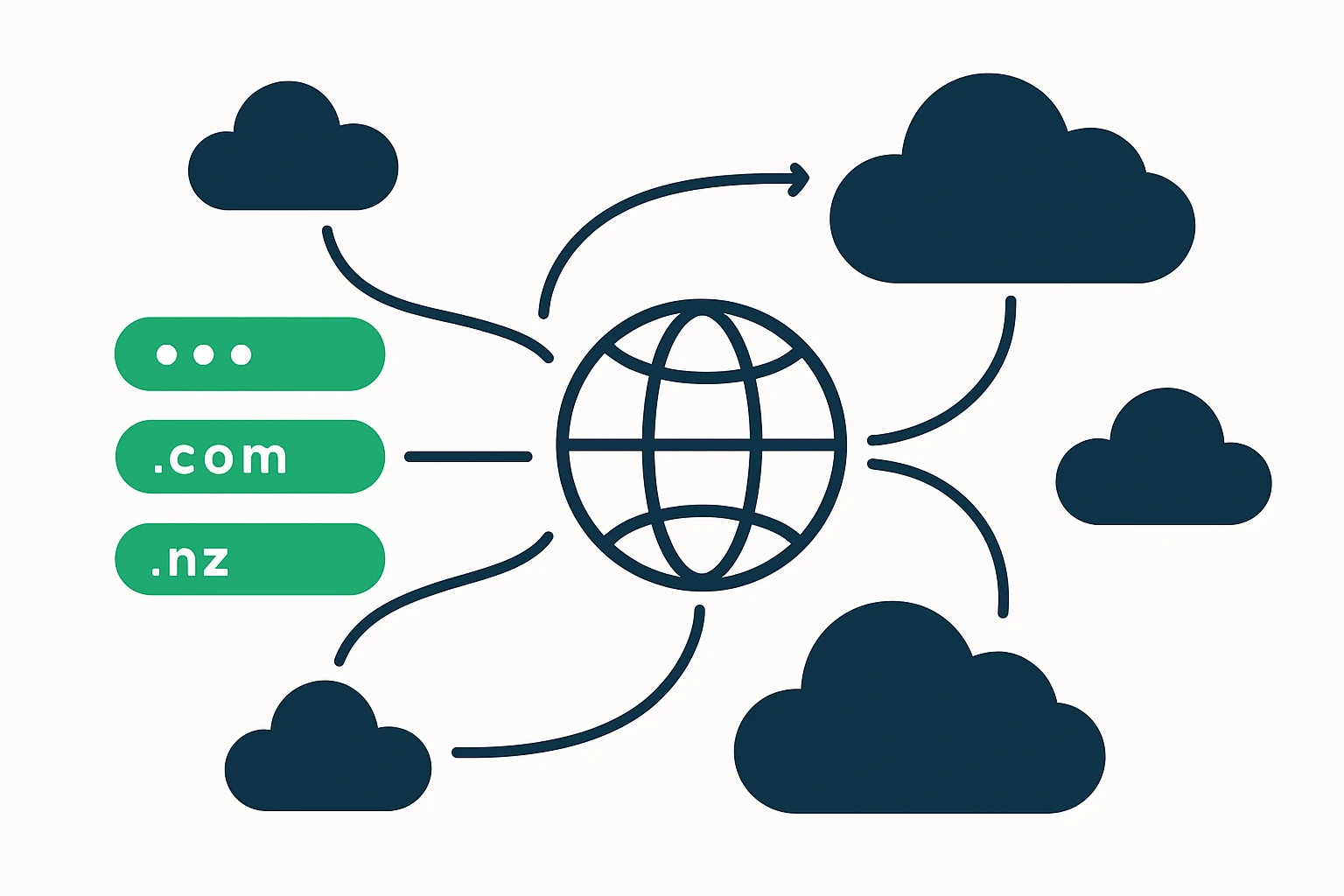
DNS failover remains a foundational tool for regional resilience. By pairing DNS health checks with regional endpoints, organizations can redirect traffic away from problematic regions without requiring user-visible downtime. The effectiveness of DNS failover hinges on two factors: accurate health checks and sensible TTLs. Aggressive TTLs reduce tuning lag, but increase DNS query load, conservative TTLs can delay failover or re-balance during rapid outages. A practical approach is to combine DNS failover with application-layer health assessment to avoid routing users to endpoints that are technically reachable but not serving correctly. TechTarget: How to optimize DNS for reliable business operations and Zytrax: Failover Strategies provide detailed best practices on implementation, timing, and validation. (techtarget.com)
Anycast routing for edge latency reduction
Anycast routing advertises a single IP prefix from multiple locations, letting Internet routing converge the query to the nearest or best-performing instance. When combined with robust health checks, anycast can dramatically reduce end-user latency and improve failover agility by steering requests toward the closest healthy edge. Real-world analyses and practitioner guides highlight anycast as a powerful mechanism for near-optimal latency in global delivery systems. (umatechnology.org)
BGP optimization and traffic engineering (TE)
Beyond DNS and anycast, BGP-based TE remains essential for controlling inbound and outbound traffic flows, especially in multi-homed environments. Techniques range from manipulating BGP attributes and communities to inflight performance routing and umbrella TE platforms that automate path selection. While BGP can be complex, modern TE tools aim to reduce risk and manual effort by identifying congested paths and re-pointing traffic to higher-performing links. Cisco’s PfR-style inbound optimization and contemporary automated TE platforms illustrate the ongoing value of BGP-aware strategies in delivering predictable performance. (cisco.com)
Observability and governance: the backbone of trustable routing
Effective routing is only as good as the visibility and governance that accompany it. Telemetry across end-user experiences, network latency, jitter, and regional uplink health enables precise decisions and faster incident responses. Industry guidance emphasizes combining network-layer routing with application-layer health signals for resilience, and using GTM-like approaches to coordinate routing policies across clouds. TechTarget and UMA Technology provide pragmatic perspectives on observability and resilience in multi-cloud contexts. (techtarget.com)
Real-world note from an industry expert: DNS-based failover is most effective when paired with continuous health monitoring and layered redundancy. Relying solely on DNS tricks without transport- or application-level checks can create a false sense of availability. This insight aligns with practitioner guidance that emphasizes multi-layer health checks and staged failover rather than single-point strategies. (techtarget.com)
A practical framework: how to design resilient multi-cloud routing
To operationalize these levers, adopt a staged framework that prioritizes measurement, policy, and verification. The following steps are designed to be actionable for teams operating SaaS platforms across AWS, Azure, Google Cloud, and other providers.
- 1) Establish baseline performance and availability targets for key user populations. Collect latency, jitter, and error-rate data across regions and clouds to set realistic objectives.
- 2) Implement DNS-based failover with health checks that cover network reachability and application-layer readiness. Balance TTLs to minimize switch latency while avoiding DNS query storms. TechTarget and Zytrax offer practical guidance on TTL tuning and health-check integration. (techtarget.com)
- 3) Deploy edge presence with anycast where appropriate, ensuring that health signals drive the routing decisions rather than static proximity assumptions. Real-world guidance highlights how anycast can reduce lookup and access latency when endpoints are healthy. (umatechnology.org)
- 4) Use BGP-based TE to optimize upstream paths and balance inbound/outbound traffic across clouds. Where possible, leverage automation that interprets TE metrics and applies policy without manual reconfiguration. Cisco: BGP Path Optimization and Noction: Routing Performance Optimization provide established patterns for inbound/outbound optimization. (cisco.com)
- 5) Maintain rigorous observability, including end-user experience metrics, health-check cadence, and cross-cloud policy validation. Alignment between network and application health is critical to avoiding misleading failovers. (techtarget.com)
Domain lists as data inputs: leveraging inventory with routing decisions
Domain inventories - especially when you operate a portfolio of brands or markets - can inform governance and risk-aware routing decisions in subtle ways. Public domain datasets (for example, lists by TLDs such as .vn, .today, or .work) are often used for brand-protection, market analysis, and digital presence planning. While these lists do not replace real-time network health checks or application monitoring, they can help security and network teams contextualize traffic patterns, assess potential exposure, and prioritize monitoring across a broader surface area. For readers curious about regional and global domain catalogs, WebAtla’s VN domain catalog and the broader List of domains by TLDs pages provide concrete examples of available inventories you might consult for governance and risk planning. (Note: use domain lists responsibly and in conjunction with live telemetry.) (cira.ca)
From a routing perspective, these inventories can complement, not replace, dynamic routing controls. They help teams identify regional expansion opportunities, assess where brand protections or domain-driven traffic steering might be warranted, and understand regional market signals that could influence proximity-based routing policies. When paired with DNS failover and GTM strategies, domain data contributes to a more holistic resilience posture. For readers exploring domain catalogs, consider consulting the domain lists by country and technology pages to understand market breadth and technology footprints. WebAtla: List of domains by Countries and WebAtla: List of domains by Technologies provide concrete examples of how marketplace intelligence can intersect with routing strategy. (cira.ca)
Limitations and cautions around domain-data inputs
Domain inventories come with caveats. They are snapshots of ownership and portfolio management at a given time, they do not reflect real-time DNS health, DNSSEC status, or current hosting configurations. They should be treated as supplementary inputs rather than primary routing levers. In practice, rely on live health checks, telemetry, and automated TE signals for day-to-day routing decisions, using domain data for governance and risk assessment only when appropriate. This aligns with industry guidance that emphasizes layered resilience and careful DNS/TE design. TechTarget and Zytrax discuss the importance of combining domain-layer strategies with real-time health signals. (techtarget.com)
Limitations, trade-offs, and common mistakes
Even a well-architected routing stack has trade-offs. Below are the most common pitfalls to avoid when building multi-cloud routing with DNS failover, anycast, and BGP TE.
- Overreliance on DNS failover without application-layer checks. DNS failover can redirect traffic quickly, but it does not guarantee that the destination is healthy at the HTTP level. Always pair DNS failover with health checks that validate both network reachability and service readiness. TechTarget provides practical guidance on layered health checks. (techtarget.com)
- Misconfigured TTLs that cause churning or, conversely, sluggish failover. TTL design is a balancing act, setting TTLs too high slows failover, while very low TTLs increases query load and potential instability. See DNS-TE best practices for TTL considerations. Zytrax offers actionable TTL guidance. (zytrax.com)
- Underestimating TE complexity in multi-cloud paths. TE is powerful but can introduce oscillations if policies conflict or are not properly scoped. Modern TE tooling (and vendor guidance) emphasizes automated, policy-driven routing to reduce human error. Noction and Cisco outline approaches to safe, effective TE. (noction.com)
- Limited observability can mask routing-induced user experience problems. A governance model that includes both network telemetry and application performance monitoring is essential to verifying that routing changes deliver the intended user impact. Industry guidance stresses end-to-end visibility as the foundation of reliable routing. TechTarget reinforces this principle. (techtarget.com)
Structured decision framework: choosing the right mix of routing controls
To help teams decide which controls to deploy when, here is compact guidance that maps needs to capabilities in a way that supports governance across clouds. Use these as a quick-reference checklist when scoping a new multi-cloud routing project.
- 1) Latency-sensitive workloads require edge-aware routing (anycast, edge caching, and proximity routing) to minimize user-perceived delays.
- 2) High-availability requirements favor DNS failover combined with GTM methodologies and cross-region health checks to reduce single points of failure.
- 3) Complex multi-cloud footprints benefit from BGP-based TE for inbound/outbound optimization and automated path selection, with strong safety controls to prevent routing instability.
- 4) Observability is non-negotiable: collect end-user latency data, health signals, and policy-violation alerts to drive continuous improvement.
- 5) Governance matters: ensure the routing policy aligns with security, regulatory requirements, and vendor strategies, including the use of security-aware DNS and TE controls.
Putting it all together: a holistic, editorially sound approach for CloudRoute readers
For teams running SaaS applications or enterprise workloads across clouds, the path to robust cloud routing combines DNS-based resilience, edge and anycast tactics, and prudent BGP/TE management. The core idea is to stop treating DNS, TE, and application health as separate silos and instead design a unified routing lifecycle: measure, policy, validate, and iterate. Domain inventories and governance data - like those seen in WebAtla’s domain catalogs - can support risk-aware planning and regional strategy, but they must be anchored by live telemetry and continuous validation. For practitioners, the most valuable takeaways are simple: bias routing toward healthy, close endpoints, keep failover fast but predictable, and ensure you can observe the impact of every routing change in real time. For organizations seeking practical help, a spectrum of services - from DNS health automation to TE-enabled BGP routing - offers a path to better cloud network performance without sacrificing stability. WebAtla VN catalog and WebAtla TLD catalog illustrate how inventory data can inform governance decisions, while CloudRoute focuses on delivering optimized cloud routing and traffic engineering for multi-cloud environments. (cira.ca)
Conclusion
Global, multi-cloud networks demand a disciplined, layered routing strategy. DNS failover, anycast edge routing, and BGP/TE-informed path selection - applied with strong observability - deliver measurable gains in latency and uptime. Domain data can enrich governance and risk assessments, but success ultimately rests on live telemetry, well-defined policies, and rigorous testing. As cloud ecosystems evolve, a forward-looking routing program will continue to reduce latency, improve resilience, and empower DevOps and SRE teams to operate with confidence across clouds.
Further reading and resources: WebAtla VN domain catalog, WebAtla: List of domains by TLDs, WebAtla pricing