Introduction
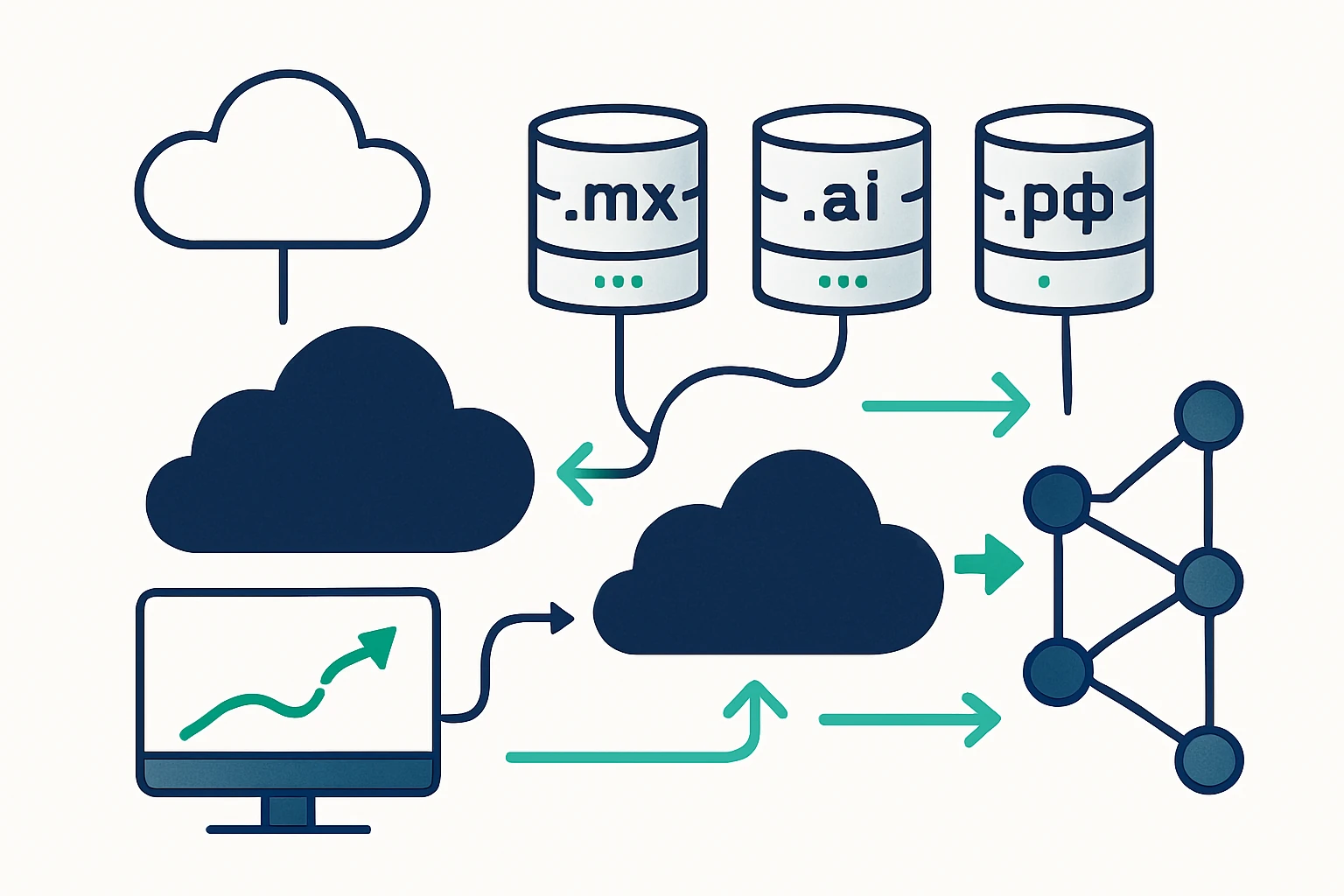
Today’s cloud-native, multi-cloud deployments demand routing that minimizes latency while preserving uptime. Static routing tables alone cannot account for the real-time, global behavior of the internet, where endpoints move, DNS health fluctuates, and regional outages can ripple across services. A practical way to sharpen traffic engineering is to bring in external, actively updated domain data feeds - especially for high-traffic TLDs. By downloading lists of .mx domains, .ai domains, and .рф (xn--p1ai) domains and integrating them with cloud routing and DNS failover workflows, operators can ground decisions in a broader, current picture of the internet’s hosting footprint. For context, WebAtla reports large, actively maintained datasets for these TLDs: 877,461 active .mx domains (last updated 2026-03-04), 828,822 active .ai domains (last updated 2026-03-17), and 794,316 active .рф domains (last updated 2026-02-10). These scales illustrate the potential to map geography, hosting patterns, and DNS health into routing decisions.
Evidence and best practices in cloud routing and traffic engineering underscore the value of reliable, resilient routing topologies and the use of dynamic routing capable of reacting to real-time conditions. Industry references emphasize high-availability techniques (for example, BGP, BFD, and graceful restart) and the importance of observability and quotas in large dynamic routing environments. See Google Cloud’s best practices for Cloud Router and learned routes for concrete guidance on dynamic routing, quotas, and policy handling. (docs.cloud.google.com)
Why domain feeds matter for traffic engineering
Domain data feeds offer a unique external vantage point. They illuminate the distribution and health of endpoints that serve as traffic anchors - for example, which domains in a given TLD have active DNS records, which ones resolve reliably, and where their hosted infrastructure resides. When integrated into routing decision workflows, these signals can help in three practical ways:
- DNS resilience and failover planning: knowing which domains and associated hosting footprints are active helps design failover strategies that minimize user impact during regional outages. Contemporary DNS resiliency resources stress the importance of health checks, low TTLs for rapid failover, and diversified delivery paths. (techtarget.com)
- Observability for multi-cloud routing: domain footprints provide a macro view of where endpoints are hosted across clouds and geographic regions, aiding geolocation-aware routing policies and cross-provider redundancy planning. Anycast and BGP-based routing often pair best with rich, current domain data to reduce reliance on stale assumptions. (thousandeyes.com)
- Risk-aware path selection: by correlating domain-level signals with dynamic routing metrics, operators can adapt path preferences and diversions to minimize latency and avoid congested regions or problematic AS paths. This aligns with best-practice guidance on dynamic routing, quotas, and path optimization. (docs.cloud.google.com)
Three TLD datasets at scale: .mx, .ai, and .рф
Understanding the scale of domain-data feeds helps frame their utility for routing. WebAtla’s datasets show substantial, actively updated inventories for these TLDs:
- .mx – 877,461 active domains, 779,905 DNS-records, 91 countries represented, Last updated 2026-03-04. This scale reflects Mexico-facing digital footprints across diverse industries and registrars. Download full list of .mx domains.
- .ai – 828,822 active domains, 744,295 domains with DNS records, 117 countries, Last updated 2026-03-17. The .ai namespace is widely used by AI-focused brands and projects, offering a globally distributed footprint. Download full list of .ai domains.
- .рф (xn--p1ai) – 794,316 active registrations, substantial DNS visibility and international distribution, Last updated 2026-02-10. This Cyrillic namespace highlights a large, localized Russian-language presence. Download full list of .рф (xn--p1ai) domains.
These pages also provide data fields that can be useful for routing decisions, such as IP addresses, DNS status, and RDAP/WHOIS records, all of which can be imported into a routing workflow. WebAtla explicitly notes that their datasets are provided in CSV format and can include RDAP/WHOIS data alongside DNS, hosting, and technology fingerprints, making them a practical source for automation and analytics. .mx dataset, .ai dataset, .рф dataset provide previews and format details. (webatla.com)
Ingesting and validating domain-feed data
To turn domain feeds into routing signals, you need a repeatable ingestion and validation workflow. WebAtla’s data catalog confirms that the datasets are delivered as structured CSV with fields such as TLD, domain, IP address, RDAP/WHOIS records, DNS status, and technology fingerprints. The datasets also advertise the availability of RDAP and WHOIS data for enrichment, which helps verify current ownership, registration status, and related attributes. This kind of enrichment supports defensive routing decisions, brand protection efforts, and more nuanced traffic engineering where you differentiate between live vs. potentially stale endpoints. .mx, .ai, and .рф pages highlight the RDF/WHOIS and DNS-status signals you can expect from these feeds. (webatla.com)
Operationally, this means you can verify that a given domain’s DNS records are present and active, and you can confirm the domain’s registration data before you trust it for routing decisions. Google Cloud’s dynamic routing documentation emphasizes that learned routes can come from remote peers and that quotas govern the number of distinct prefixes you advertise, underscoring the need for validation and governance when bringing new data into production. (docs.cloud.google.com)
From data to routing policy: integrating domain feeds into a cloud routing stack
Domain feeds become actionable routing signals when translated into the same decision loops that already govern BGP, dynamic routing, and DNS failover. A practical mapping looks like this:
- Ingestion and normalization: pull daily or delta updates from the domain feeds, convert to a consistent internal schema, and align with the Public Suffix List to manage TLD hierarchies. WebAtla’s public-facing data strategy notes alignment with standard suffix parsing, which helps ensure consistency across downstream processes. Active domains database and tld MX pages illustrate this approach. (webatla.com)
- Validation and enrichment: verify DNS health and RDAP/WHOIS data for each domain, ensuring you’re modeling live assets rather than stale placeholders. This reduces the likelihood of routing decisions tied to defunct or misregistered hosts. Google Cloud’s learned-routes and quotas guidance supports treating dynamic-route prefixes with care and governance. (docs.cloud.google.com)
- Policy mapping to routing: convert domain signals into routing attributes (for example, mapping DNS health and hosting region to BGP next-hop selection, MED values, or inter-regional costs). In a cloud-router context, you’ll operate under regional vs global dynamic routing modes, which control how prefixes are learned, exported, and used for path selection. The official docs explain these modes and how they interact with custom learned routes. (docs.cloud.google.com)
- Observability and governance: build dashboards that correlate domain-feed health with routing performance metrics (latency, jitter, path stability). Use quotas and alerting to avoid overloading the control plane while maintaining visibility into dynamic routing behavior. Google Cloud’s best-practice guidance emphasizes alerting on learned routes and quotas. (docs.cloud.google.com)
Structured framework for using domain feeds in traffic engineering
Below is a concise framework to operationalize domain feeds within a cloud routing and traffic-engineering program. It is designed to be implemented incrementally and to scale with data volumes from high-growth TLDs like .mx, .ai, and .рф.
- Ingestion cadence - establish daily and delta-update ingest to keep feeds fresh without overwhelming the control plane. The datasets from WebAtla are updated on a schedule that is visible on each TLD page (for example, .mx last updated 2026-03-04, .ai last updated 2026-03-17). (webatla.com)
- Normalization and suffix handling - normalize domain entries to a consistent schema and use the Public Suffix List to correctly interpret multi-level domain suffixes (this is explicitly noted as WebAtla’s standard approach). (webatla.com)
- Enrichment - attach RDAP/WHOIS data and DNS-health signals to each domain to validate current ownership and hosting state. This reduces false positives when feeding routing decisions. (webatla.com)
- Routing policy translation - translate domain-health signals into routing primitives (for example, selecting next hops, adjusting MED values, or exporting inter-region costs) in line with dynamic routing modes (regional vs global) and quotas described in Google Cloud’s docs. (docs.cloud.google.com)
- Observability and governance - align dashboards with runbooks for who can modify routing policies and how decisions are reverted if feeds become stale or show anomalies. Best-practice guidance for Cloud Router highlights alerting on learned routes and quota management. (docs.cloud.google.com)
Limitations and common mistakes
- Data freshness vs. cost: even though the datasets show high activity, keeping every domain in a live loop can overwhelm the control plane and complicate decision logic. Balance delta updates with meaningful thresholds, and beware of TTL-driven propagation delays in DNS failover. Industry discussions on DNS failover emphasize TTL tuning, health checks, and cross-provider synchronization to avoid false alarms and latencies. (techtarget.com)
- Over-reliance on domain data: domain lists are powerful signals, but they do not replace real-time routing telemetry. Use domain feeds as one input among many (latency measurements, real-time DNS responses, and inter-domain relationships) to guide decisions rather than dictate them. Industry sources on DNS optimization stress a layered approach combining DNS, CDN, and routing signals. (techtarget.com)
- Complexity of global routing decisions: BGP-based routing with global dynamic routing involves intricate policy interactions. Ensure that quotas, AS-path considerations, and inter-region costs are understood and tested to prevent unintended traffic steering. Google Cloud’s documentation highlights these complexities and offers concrete guidance on quotas and best-path selection. (docs.cloud.google.com)
Expert insight and practical caveats
Expert insight: In modern cloud networks, dynamic routing and health-aware decisioning are most effective when paired with robust transport-layer health signals like Bidirectional Forwarding Detection (BFD) and authenticated BGP sessions. Google Cloud’s best-practices guide explicitly recommends enabling BFD for fast failure detection and MD5 authentication for BGP sessions in appropriate deployments, along with graceful restart to minimize disruption during failovers. This posture reduces the chance that routing decisions are based on stale topology or transient anomalies. (docs.cloud.google.com)
Conclusion
Domain data feeds for TLDs such as .mx, .ai, and .рф offer a technically credible lever to enhance cloud routing and multi-cloud traffic engineering. When ingested, validated, and mapped into routing policies, these feeds complement real-time telemetry and best-practice routing frameworks to reduce latency, improve uptime, and strengthen DNS resilience. The approach is practical: start with structured CSV feeds, leverage available RDAP/WHOIS data for enrichment, and translate domain-health signals into dynamic routing decisions within the constraints of modern cloud routers and BGP policy. As with any data-driven control plane, balance freshness with operational safety, maintain clear governance, and continuously observe the impact of domain-driven routing choices on end-user experience. For teams ready to explore domain feeds as a strategic asset, WebAtla’s .mx, .ai, and .рф datasets provide a scalable, well-documented starting point. .mx dataset, .ai dataset, .рф dataset can anchor an evidence-based, risk-aware routing program.
External references
- Google Cloud, Best practices for Cloud Router: https://cloud.google.com/network-connectivity/docs/router/concepts/best-practices
- Google Cloud, Learned routes: https://cloud.google.com/network-connectivity/docs/router/concepts/learned-routes
- ThousandEyes, What is Anycast IP Addressing?: https://www.thousandeyes.com/learning/techtorials/anycast
Additional reading and data sources used in this article include the following domain-data references: .mx domain list, .ai domain list, and .рф domain list.