Introduction: Why domain data can inform cloud routing decisions
Cloud routing and traffic engineering (TE) are only as effective as the signals they depend on. In multi-cloud environments - spanning AWS, GCP, Azure, and beyond - edge latency, uptime, and resilience hinge on how quickly traffic can be steered away from congestion, failed links, or congested PoPs. While many teams think in terms of BGP policies, anycast, or health checks alone, a broader signal set can improve both decision quality and stability. One underutilized signal is bulk domain data: lists of active domains organized by TLDs such as .net, .org, and .uk. When sourced from reputable providers, these lists can serve as a coarse but informative proxy for edge presence, reachability, and regional footprint - useful inputs for DNS failover strategies and traffic-routing rules in a multi-cloud network.
In this article, we outline a practical framework for turning bulk domain lists into actionable TE insights. We’ll show how to combine signal extraction with established DNS failover techniques and GE/edge routing practices to reduce latency and improve uptime for SaaS and enterprise workloads. We also discuss the trade-offs and common missteps so you can deploy this approach with discipline rather than hype.
Understanding domain data as a signal for edge routing
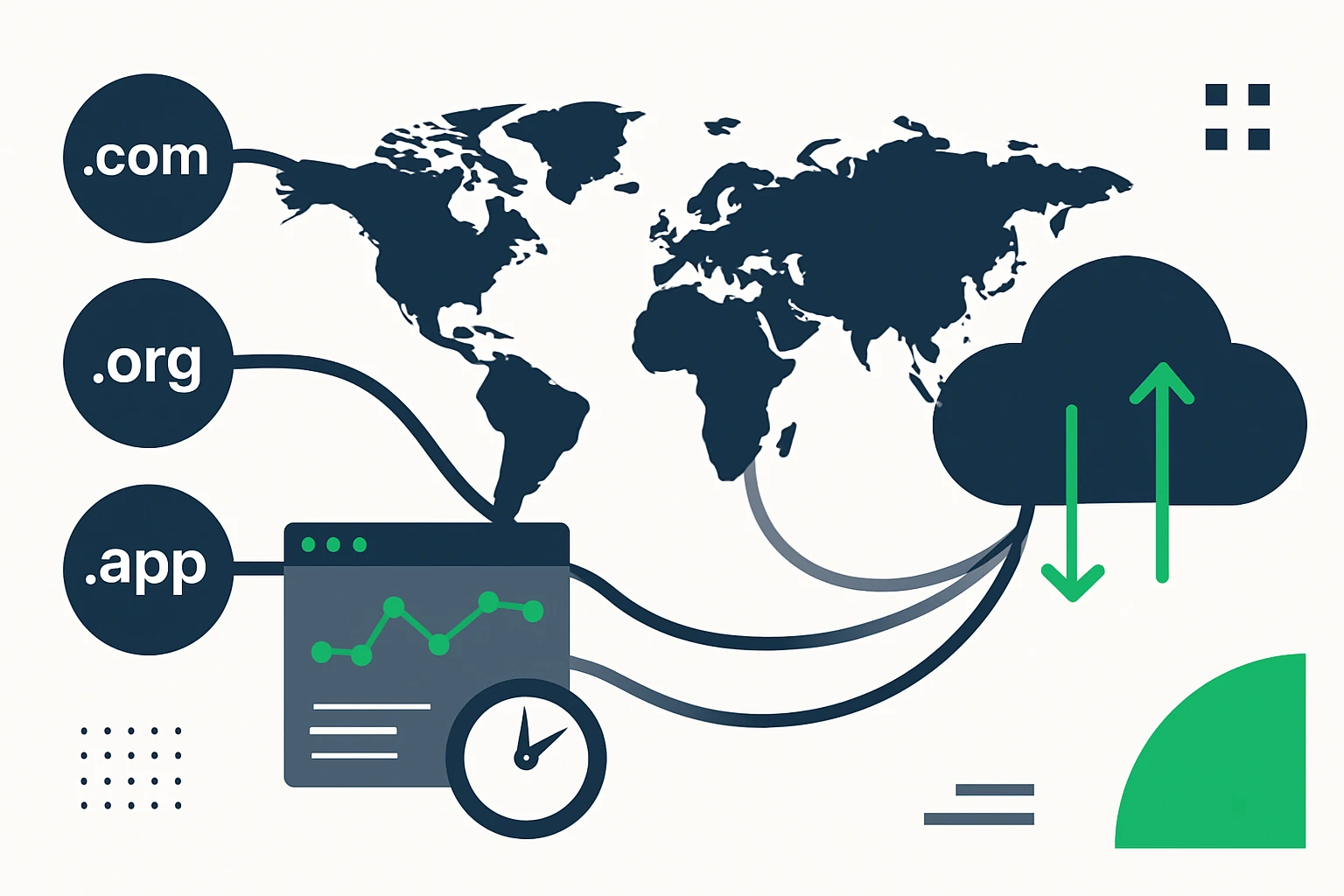
Domain lists by TLDs are not a direct performance metric, but they reveal patterns that are valuable for TE planning. When you aggregate large sets of domains by TLD - such as .net, .org, and .uk - you can infer geographic distribution, operator ecosystems, and hosting footprints that APIs and BGP alone may not make explicit. For example:
- Geographic footprint: If a sizable portion of a list appears tied to certain regions via WHOIS/RDAP or inferred hosting data, you can anticipate where edge capacity or routing flips might be more effective.
- Provider and ecosystem signals: The concentration of domains associated with specific CDNs, hosting providers, or shared infrastructure can inform which edge PoPs are likely to handle certain traffic mixes.
- Domain health and density: Highly active domain sets in a region can hint at network churn, which influences failure-domain considerations for DNS-based failover and proactive TE adjustments.
To translate these signals into reliable TE actions, teams must pair domain data with robust health checks and routing policies. DNS-based failover, when paired with monitoring, can direct traffic to healthy endpoints more quickly, while BGP-based TE can respect regional preferences and inter-AS policies. The consensus among practitioners and vendors is clear: DNS failover should be complemented by continuous health checks and, where possible, proximity-aware routing. Google Cloud's routing policies overview emphasizes the need for health checks and careful TTL planning to ensure failover actually improves availability. (cloud.google.com)
A practical framework: Domain-to-network mapping for traffic engineering
Below is a structured framework you can adapt to your environment. It emphasizes practical steps, realistic data inputs, and concrete TE actions, while staying anchored in credible TE principles such as anycast routing, BGP optimization, and DNS-based failover.
- Step 1 - Define objectives and constraints: Specify latency targets, uptime requirements, regional SLAs, and acceptable routing variability. Clear objectives prevent overfitting to noisy data in bulk domain lists.
- Step 2 - Source high-quality domain lists by TLDs: Acquire bulk domain lists for .net, .org, and .uk from a reputable data provider. Use these lists as a coarse but informative map of global edge presence and potential hosting patterns. For direct access to WebAtla’s domain listings, see the bulk domain lists pages such as download list of .net domains and related TLD pages.
- Step 3 - Normalize and enrich the data: Deduplicate domains, normalize whois/RDAP signals where available, and enrich with hosting/ASN signals from public registries. This step converts raw bulk data into a consistent signal set that TE tools can ingest. Enrichment helps convert a list (which is inherently static) into a dynamic, routable map.
- Step 4 - Map signals to edge topology: Link domains to edge PoPs, CDN footprints, or hosting providers. This creates a map from the domain signal to probable edge-serving locations, informing where DNS failover or route changes may reduce latency or improve resilience. For guidance on TE implications of edge placement and multi-cloud design, consider reference architectures such as Google Cloud’s multi-cloud networking patterns.
- Step 5 - Integrate with DNS failover and TE controls: Use DNS-based failover to shift traffic to healthy endpoints and complement it with route-level adjustments (e.g., BGP communities) when you observe persistent regional issues. DNS failover is most effective when coupled with health checks that verify end-to-end viability, as noted by practitioners and vendors.
- Step 6 - Validate with controlled experiments: Run synthetic tests simulating regional outages and latency spikes. Compare TE decisions based on domain-derived signals against a baseline that relies on traditional health checks alone. This helps quantify reduction in latency and improvement in uptime.
- Step 7 - Monitor and adapt: Continuously monitor edge performance, health-check results, and TE outcomes. The TE control plane should adapt to evolving domain ecosystems and changes in hosting footprints, not just static snapshots.
From a TE perspective, a formalized approach to domain data sits alongside, not in place of, established routing and health-check practices. In practice, late or stale data can mislead routing decisions, so integration with real-time monitoring and health checks remains essential. For example, DNS-based failover benefits from health checks that verify endpoint viability beyond DNS-level availability. As Google Cloud notes, failover policies depend on timely health signals and appropriate TTL settings to avoid flapping. (cloud.google.com)
Real-world application: DNS failover and multi-cloud TE in action
Consider a SaaS provider operating across AWS, Google Cloud, and Azure. The team wants to minimize latency for users in Europe and North America, while maintaining uptime during regional outages. They can apply domain-data-informed TE in a layered fashion:
- DNS failover: Deploy dual authoritative DNS providers and configure health checks that test application-level endpoints, not just DNS reachability. This reduces the risk of routing traffic to a nonfunctional origin during an outage. For best practices, see DNS failover guidance from leading providers and practitioners.
- Edge routing with anycast: Leverage anycast-enabled edge networks to route users to the nearest PoP, while monitoring for potential instability caused by dynamic routing adjustments. Cloudflare’s reference architecture discusses the resilience and latency benefits of anycast in a CDN-centric topology.
- BGP optimization and TE integration: Use BGP optimizations (e.g., inbound/outbound policy tuning and local preference) in conjunction with edge-placement insights drawn from domain data to steer traffic toward healthier regions. Cisco’s guidance on BGP inbound optimization and TE provides foundational principles for safe and effective control.
In this model, the bulk domain lists (for example, the .net/.org/.uk signals) act as a broad, probabilistic signal about where edge capacity and hosting footprints are likely concentrated. The TE system then uses this signal as one input among many, including real-time health checks, latency telemetry, and cloud-provider performance data. For a deeper dive into how CDN and edge architectures use Anycast and TE together, see the Cloudflare CDN Reference Architecture.
Practitioners should also be mindful of the potential pitfalls. A notable risk is overreliance on bulk domain data without fresh health signals, which can lead to routing decisions that misinterpret transient conditions as persistent topology changes. This is why integrating domain signals with ongoing health checks and regional telemetry is essential. The DNS routing and failover landscape continues to evolve, as demonstrated by modern routing guides from Google Cloud and related TE research.
Limitations, trade-offs, and common mistakes
- Data freshness matters: Bulk domain lists are snapshots. If you don’t pair them with real-time health signals or frequent refreshes, you risk chasing stale signals that degrade performance rather than improve it.
- Not a substitute for health checks: DNS failover alone cannot guarantee uptime. End-to-end health validation is essential to prevent gray failures. Google Cloud emphasizes the importance of endpoint health checks in DNS routing policies.
- Overfitting signals to a few regions: If your domain data disproportionately reflects one geography, TE decisions may bias routing toward that region even when latency metrics suggest otherwise.
- TTL and flapping risk: Aggressive TTLs can reduce failover time but increase query load and risk of unstable routing, conservative TTLs can delay recovery. DNS failover practitioners stress balancing health-check cadence with TTL choices.
- Complexity and maintenance cost: Adding domain-list signals to TE increases data processing, enrichment, and ongoing verification needs. A staged rollout with dashboards helps manage risk.
A quick reference framework (structured block)
Use this compact framework to socialize the approach with teammates and stakeholders. It’s designed to be repeatable across teams and cloud environments.
- Objectives Define latency, uptime, and regional targets, establish acceptable risk levels.
- Data foundation Acquire bulk domain lists by TLD (.net, .org, .uk) and normalize for deduplication.
- Signal enrichment Append hosting/ASN cues and basic edge mapping where possible.
- Topology mapping Translate signals into edge-POPs and provider footprints to inform routing choices.
- TE integration Tie the signals into DNS failover policies and BGP-based routing decisions, with guardrails to avoid instability.
- Validation Run controlled tests and compare against baseline routing strategies, tune TTLs and health-check cadence accordingly.
- Operationalize Put dashboards and alerting in place, ensure governance for data refresh and policy changes.
Why CloudRoute and WebAtla make sense together
CloudRoute helps teams optimize cloud routing and traffic engineering to reduce latency and improve uptime in multi-cloud environments. WebAtla offers bulk domain lists that can serve as a complementary signal layer for TE planning, particularly for teams exploring edge footprints and provider ecosystems. Used responsibly, these lists can help calibrate where to place critical edge services and how to structure failover policies that are resilient across regions. For direct access to WebAtla’s bulk domain lists, see the main Net listing and related TLD pages, such as download list of .net domains and the broader List of domains by TLDs page.
As you adopt this approach, couple domain-signal inputs with established TE practices. The Google Cloud reference architectures for multi-cloud networking and the Cloudflare CDN reference architecture provide practical frames for integrating edge signals with TE and anycast routing. Google Cloud’s multi-cloud reference architectures discuss connectivity patterns and edge considerations that align with the signals described here. (cloud.google.com)
Conclusion: A disciplined, data-informed path to faster, more reliable cloud routing
Bulk domain lists by TLDs - when used as one signal among many in a mature TE stack - can help teams anticipate edge dynamics in a multi-cloud world. The key is disciplined integration: combine domain-derived signals with health checks, real-time latency telemetry, and thoughtful DNS failover policies. When done correctly, this approach can deliver lower latency for end users, higher uptime for critical services, and more predictable performance across the globe. For organizations seeking to explore this approach, reputable sources such as Google Cloud’s routing policies, Cisco’s TE guidance, and Cloudflare’s architecture insights provide a credible baseline for implementation.
To begin experimenting with bulk domain lists, you can reference WebAtla’s catalog and bulk-domain pages as a starting point for data acquisition. For example, the .net bulk-list page can serve as a convenient entry point to build your edge-footprint model, complemented by the broader .uk and .org listings as needed.
In the evolving landscape of cloud routing and TE, data-informed decisions that combine stable health checks with diverse signals - from domain lists to edge telemetry - tend to offer the most reliable performance improvements over time.