Introduction: Why TLD search matters for cloud routing
In modern multi-cloud deployments, the choice of top-level domains (TLDs) is not merely a branding decision. It shapes how traffic is directed across regions, how DNS lookups resolve at edge nodes, and how resilient your services are to outages. The TLD layer sits at the root of the Domain Name System (DNS) and is governed by global bodies such as IANA and ICANN. Registry operators deploy distribution strategies that can influence latency and uptime for users worldwide. For context, IANA maintains the root zone and lists all active TLDs, while Verisign helps maintain the root and operates major TLDs like .com and .net. IANA Root Zone Database and Verisign describe how these layers work together to power the internet.
Why TLDs matter for cloud routing and multi-cloud networks
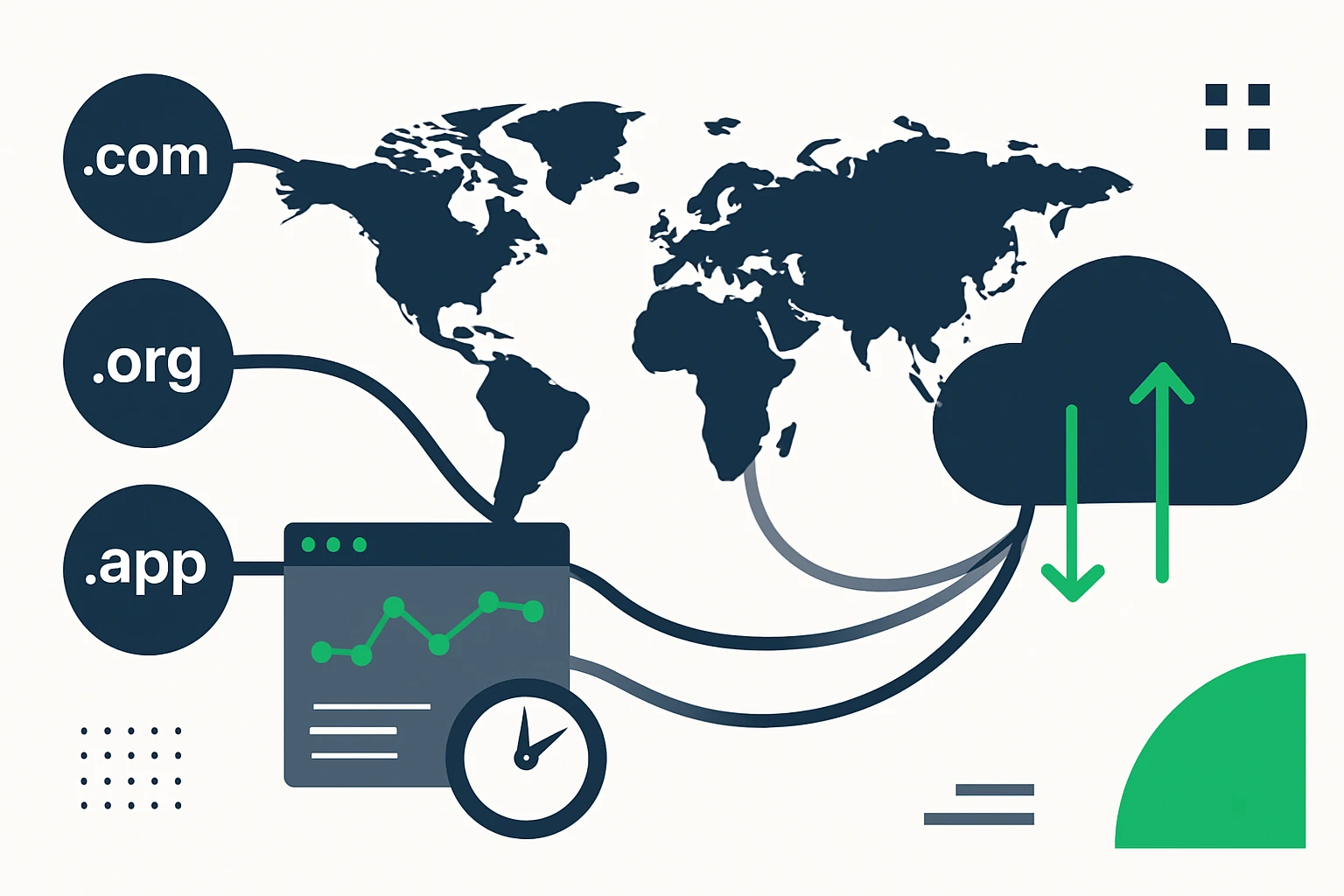
Every DNS resolution ultimately touches the authoritative servers for the TLD in question. The registry ecosystem today increasingly relies on anycast networks to place DNS responses closer to users, reducing latency and improving resilience. This is not merely theoretical: industry observers note the growing prevalence of anycast deployments across TLD infrastructure, which can shorten the distance between a resolver and the TLD’s authoritative servers. For a deeper look, see APNIC’s analysis of anycast in the DNS. APNIC: How widely adopted is anycast in the DNS? The practical upshot for cloud routing is that the TLD you choose can influence the resolution path, end-user latency, and failover behavior when traffic is steered across multiple clouds or edge locations. Globally, the root zone is managed under the auspices of IANA/ICANN, and major registries like Verisign provide authoritative data for core TLDs such as .com and .net. Verisign.
Core considerations in a TLD search for cloud routing
When evaluating the vast landscape of TLDs for a cloud-first strategy, a few questions matter most:
- Registry resilience and anycast presence: Do the TLD’s authoritative servers sit behind anycast, and where are the major PoPs (points of presence) relative to your users? This can materially affect DNS latency and failover speed. APNIC analysis provides a foundation for understanding how anycast shapes DNS performance at scale.
- Governance and stability: Which organizations govern the TLD, and how stable is the registry operating environment? The governance framework is typically coordinated by ICANN and the IANA root zone, ensuring consistent policy across registries. See ICANN’s overview of generic TLDs for context on governance and policy coordination. ICANN
- Global distribution and latency footprint: Are there regional registry configurations or DNS ecosystems that favor certain geographies? The DNS ecosystem’s geography can influence end-user latency when queries traverse long distances to reach an answer. For reference data on how root zone maintenance and TLD deployment are organized, consult the Root Zone Database maintained by IANA. IANA Root Zone Database
- Security and operational readiness: Do the TLDs support modern DNS security extensions (DNSSEC) and robust abuse handling? Registry operators increasingly emphasize security features as part of the delivery chain. See industry discussions on DNS security and registry resilience.
- Branding vs. performance trade-offs: A brand TLD can offer marketing benefits, but may introduce adoption, cost, or technical considerations that affect traffic engineering. Consider these trade-offs alongside growth plans and multi-cloud routing strategies.
These criteria form the backbone of a TLD search that aligns with cloud routing goals, especially for organizations operating across AWS, Google Cloud, and Azure or spanning multiple regions. For reference data on the scale and structure of TLDs, the IANA Root Zone Database remains the canonical source for active TLDs. IANA Root Zone Database The registry layer and root infrastructure are the backbone of global DNS, and major registries publish data and best practices for resilience and performance. Verisign provides further detail on how root zone maintenance and TLD zone files operate at scale.
A practical TLD decision framework for cloud routing
To translate these considerations into action, use a simple decision framework that maps TLD characteristics to your traffic engineering goals. The table below summarizes a structured approach you can apply when evaluating candidates in the wild TLD landscape.
| TLD Type | Trade-offs | Use Case | |
|---|---|---|---|
| General TLD (gTLD) | Broad recognition, large registrant base, flexible branding | Registry performance varies, renewal costs and policies differ | Mass-market SaaS with global reach |
| Country-code TLD (ccTLD) | Strong local presence in specific markets, can improve trust and local user perception | Geographic scope can complicate global routing, some ccTLDs have stricter registry rules | Regionally targeted services (e.g., EU, DACH, APAC markets) |
| Brand TLD (e.g., .cloud, .corp, etc.) | Brandable identity, predictable namespace for marketing campaigns | Adoption risk, typically higher upfront costs and more complex DNS in some cases | Enterprise branding and controlled ecosystem traffic |
Inside this framework, you’ll often find that a layered TLD strategy - combining a primary gTLD with selective ccTLDs for regional reach and perhaps a branded TLD for campaigns - supports both performance and brand goals. An editorial approach to this framework is to pair it with TLD zone file data and the root zone governance context described earlier, ensuring your routing decisions are grounded in current registry realities.
Case study: mapping TLD choices to multi-cloud traffic engineering
Consider a SaaS provider delivering a critical API across North America, Europe, and Asia. The company operates across AWS, Google Cloud, and Microsoft Azure, with traffic patterns that shift by region and time of day. A pragmatic TLD strategy for this scenario might include:
- Primary gTLD: Use a globally recognized gTLD (e.g., .com) to anchor brand identity and simplify broad user trust, while leveraging edge DNS with anycast to minimize latency. This aligns with the general expectations of end users and reduces geolocation complexity in DNS routing.
- Regional ccTLDs: Add region-targeted ccTLDs (e.g., .de for Germany, .jp for Japan) to improve local search experience, support local compliance considerations, and reduce perceived distance for users in those regions. When traffic shifts regionally, DNS responses can steer users toward nearby clusters with lower latency.
- Brand TLDs for campaigns: If the company runs large-scale marketing campaigns or has a dedicated partner network, a brand TLD can provide a contained namespace for traffic that should be managed under controlled routing policies.
How would this look in practice? A multi-cloud routing plan would pair the primary gTLD with regional ccTLD fallbacks and, where appropriate, brand TLD campaigns. The DNS strategy would be supported by reliable DNS providers and edge-oriented routing policies that direct users to the closest healthy edge or regional cloud instance. For context on the scalability and governance of TLDs, see IANA’s root zone references and the Verisign zone-file documentation. IANA Root Zone Database • Top-Level Domain Zone File Data.
Practical integration: where the WebAtla directory fits in
For teams evaluating the practical availability and breadth of TLDs, a directory like WebAtla’s can be a helpful reference. Their TLD listings and country/technology filters offer a concrete view of what domains exist under each extension. See WebAtla’s TLD directory for a snapshot of domains by TLD, and explore specific pages such as .com domain listings to see how brands map to real-world registrations. This kind of resource is useful when planning branding, compliance, and DNS governance as you harmonize multi-cloud routing with a coherent domain strategy.
Limitations, trade-offs, and common mistakes
Even with a structured TLD search, several caveats deserve attention. First, DNS-based traffic steering has limits: DNS responses are cached at resolvers, so failover may not be instantaneous during outages. For this reason, DNS-based failover should be combined with application-level health checks and strategic load balancing. The importance of DNS-driven resilience is highlighted in best-practices guides and industry analyses. DNS Active Failover and Digital Continuity discusses how active failover complements DNS to improve reliability.
Another limitation is registry-specific behavior: some ccTLDs or brand TLDs may have unique registration rules, cost structures, or DNS configurations that complicate global routing if not planned carefully. Registry failover planning, as discussed in ICANN’s practice-oriented materials, reinforces the need for contingency strategies that do not rely on a single TLD or registry. Draft Registry Failover Best Practices
Limitations section: common mistakes to avoid
- Assuming more TLDs automatically improves SEO or user adoption, the value comes from alignment with routing strategy and brand goals, not sheer quantity.
- Relying on DNS failover alone for outage resilience, always couple DNS with health checks and a multi-provider edge strategy to reduce single points of failure.
- Overcomplicating the namespace with too many niche TLDs without a clear governance model or automation for DNS configuration and monitoring.
Conclusion: a disciplined, scalable approach to TLD search for cloud routing
Modern cloud routing and traffic engineering demand more than a brand-centric view of domains. By conducting a structured TLD search - considering registry resilience, anycast deployment, governance, and regional latency - and by applying a clear decision framework, organizations can align their domain strategy with multi-cloud traffic engineering goals. This alignment helps ensure global reach, predictable performance, and resilient uptime across AWS, GCP, and Azure footprints. For teams starting from a clean slate, begin with a globally recognizable gTLD, add targeted ccTLDs for key markets, and reserve a brand TLD where marketing campaigns necessitate controlled routing. And for teams exploring breadth, keep a live, auditable view of your TLD inventory using authoritative references such as the IANA root zone data, Verisign zone-file information, and credible DNS-resilience literature. IANA Root Zone Database • Top-Level Domain Zone File Data - these sources ground your decisions in the current reality of the TLD landscape. Finally, consult internal references like latency optimization and anycast routing playbooks to translate the theory into operational routing rules that power your multi-cloud performance.
Interested in how a domain directory can inform your strategy? See WebAtla’s TLD directory for a practical inventory of domains by extension, which can help validate your TLD choices as you design a global traffic engineering plan.