Introduction: why TLDs matter in cloud routing
Global SaaS networks face a constant balancing act: delivering low latency, high uptime, and a consistent user experience across diverse geographies. A factor that often gets overlooked is the choice of top-level domains (TLDs) and how those extensions interact with DNS routing, Anycast infrastructure, and multi-cloud traffic engineering. In this article, we dissect how tld extensions influence DNS resolution paths, latency profiles, and disaster-recovery setups for cloud-native architectures. We also offer a practical framework you can apply when aligning TLD strategy with your cloud routing and traffic engineering goals. For readers seeking data-driven TLD mappings, WebAtla maintains a comprehensive directory of domains by TLDs you can reference as you plan global routing. WebAtla’s TLD directory and the .com TLD catalog provide useful context for registrar availability and registry coverage as you design your strategy.
Understanding TLD extensions: gTLDs vs ccTLDs and why they matter
Top-level domains (TLDs) sit at the apex of the DNS hierarchy. The Internet Assigned Numbers Authority (IANA) maintains the root zone, delegating each TLD to a registry operator. TLDs are broadly categorized into generic TLDs (gTLDs) and country-code TLDs (ccTLDs). This distinction matters for routing, latency, and compliance in global networks. The root-zone management and the set of recognized TLDs are overseen by IANA and ICANN, with policy and delegation coordinated through formal processes. (iana.org)
For practitioners, it’s useful to view TLD management as two layers: the registry layer (who operates the TLD) and the DNS resolution layer (how resolvers navigate to the correct authority). The registry landscape has evolved with ICANN’s Generic Top-Level Domain (gTLD) program, expanding the available extensions and thereby affecting how brands map to global infrastructures. (icann.org)
How TLD choices influence DNS routing and latency
DNS resolution, while often viewed as a short step in the user request path, can materially impact perceived latency when you operate across multiple geographies and clouds. A key enabling technology in modern cloud routing is Anycast, which allows a single IP address to be served by multiple data-center locations. When a user’s DNS query resolves to an Anycast-enabled endpoint, the traffic is steered toward the nearest healthy facility, reducing round-trip time and improving resilience to localized failures. This approach is widely used by major providers to minimize latency and DDoS exposure. (cloudflare.com)
Practically, the TLD you choose interacts with where your DNS records are anchored and how resolvers reach your authoritative servers. While the TLD itself does not single-handedly determine latency, the registry’s geographical presence, registry policies, and propagation timing can influence failover behavior and routing paths, especially for multi-region deployments. Industry practitioners often pair TLD strategy with Anycast-enabled networks and global DNS services to shave precious milliseconds off the user experience. (cloudflare.com)
DNS failover and multi-cloud routing across TLDs
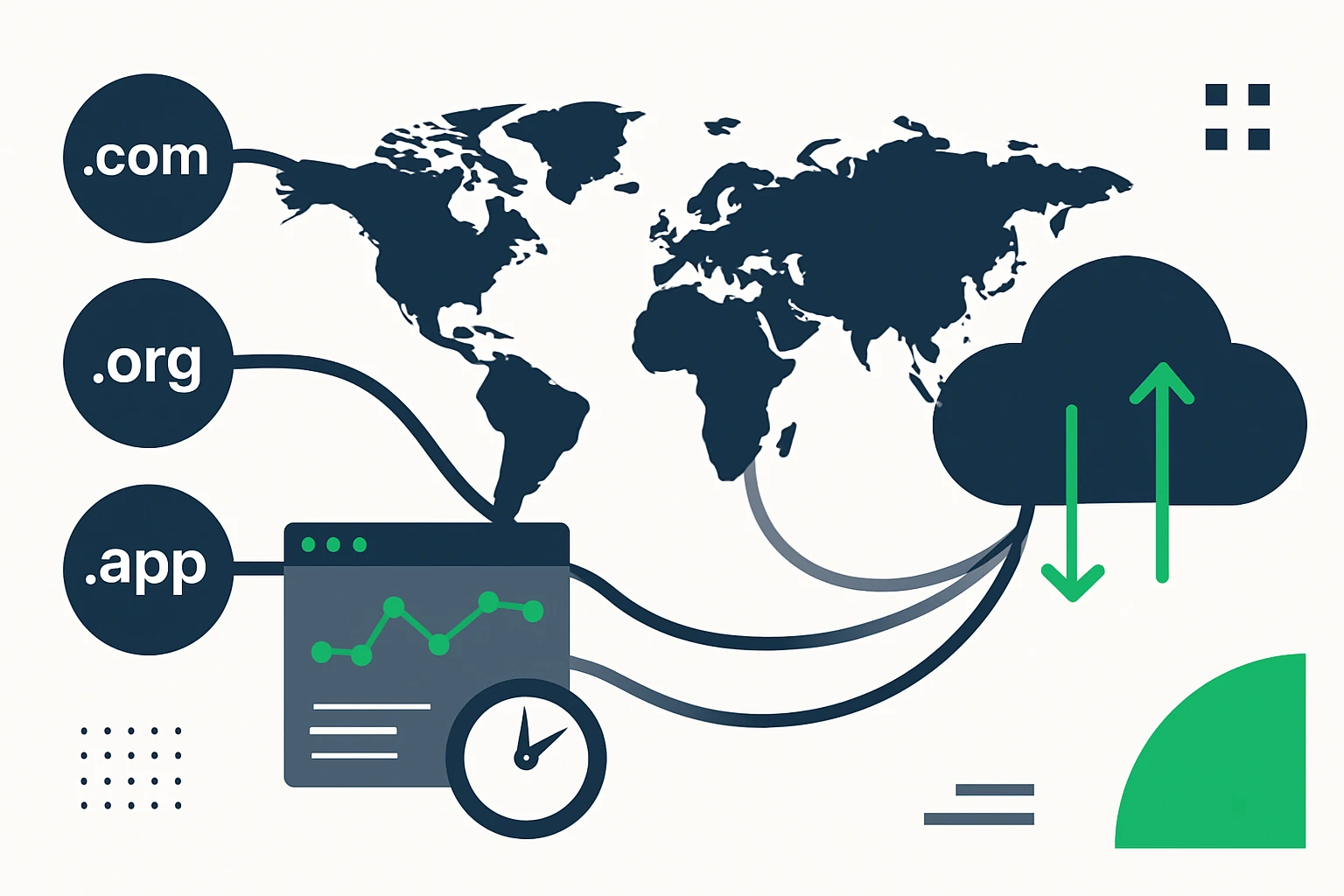
In multi-cloud architectures, DNS failover is a primary mechanism to maintain uptime when a region or cloud segment experiences trouble. Modern DNS services support health checks and failover policies that automatically re-route traffic to healthy endpoints across regions or providers. For example, Route 53 (AWS) offers failover capabilities and latency-based routing to direct users to the nearest healthy region, which is particularly important when you’re leveraging multiple clouds and a diverse set of TLDs. (aws.amazon.com)
When designing DNS failover across TLDs, consider TTL strategies, health-check cadence, and the potential for DNS caching to delay failover. In practice, combining DNS failover with anycast-inspired routing and constant monitoring yields a more robust global posture than any single technology alone. AWS documentation and best practices emphasize these patterns for reliable DNS availability in multi-region deployments. (docs.aws.amazon.com)
A practical framework for TLD strategy in global cloud networks
Below is a concise framework you can apply to plan TLD extensions in tandem with your cloud routing and traffic engineering efforts. The steps are designed to be actionable and technology-neutral, while remaining compatible with major cloud networks (AWS, GCP, Azure) and with Anycast-enabled routing techniques.
- Define latency targets by geography: map end-user regions to expected latency budgets and identify where TLD coverage aligns with regional reach. Consider both ccTLDs for local identity and gTLDs for global reach.
- Assess registry and DNS reach: evaluate the registry’s geographical presence, DNS infrastructure, and anycast capabilities associated with the TLDs you intend to use. This informs where you place authoritative DNS and how you plan failover. WebAtla’s TLD directory can provide practical visibility into TLD availability across registries.
- Design a multi-layer DNS strategy: pair DNS failover with latency-based routing and health checks to ensure users land in healthy regions with minimal latency. Refine TTLs to balance cache efficiency and failover speed. AWS DNS best practices illustrate how to optimize queries for reliability. (aws.amazon.com)
- Integrate Anycast routing for edge reach: deploy Anycast-enabled DNS and networking paths to route traffic to the closest healthy data center, reducing dependency on any single site. Cloudflare’s experience with Anycast demonstrates the performance and resilience benefits in practice. (cloudflare.com)
- Coordinate with multi-cloud routing: ensure your BGP policies, route announcements, and cross-cloud connectivity align with your DNS routing plan. Cloud Router and BGP optimization practices from cloud providers can help sustain stable, low-latency paths in complex topologies. (docs.cloud.google.com)
The result is a cohesive, resilient framework where TLD choices do not stand alone but participate in an integrated, global routing posture. For teams needing a consolidated data source on TLD coverage and registries, WebAtla’s catalog (linked above) is a practical starting point as you model registry reach and DNS anchor points alongside your cloud routing plan. WebAtla’s TLD directory
Limitations, trade-offs, and common mistakes
While the above framework helps structure TLD decision-making, several caveats deserve explicit attention:
- Registry outages and uneven coverage: even widely used TLDs can experience registry-level issues that disrupt DNS queries. Regular monitoring and failover readiness are essential. (ICANN/IANA governance notes the complexity of root-zone management and registry operations.) (icann.org)
- Over-reliance on a single TLD for global reach: a single TLD cannot guarantee global resolver reach or latency symmetry. A mix of gTLDs and ccTLDs, thoughtfully positioned, generally yields better regional coverage. (iana.org)
- TTLs vs failover speed: aggressive TTLs can undermine caching efficiency, while overly long TTLs slow failover. Align TTLs with your health-check cadence and recovery targets. AWS guidance and best practices address these trade-offs. (docs.aws.amazon.com)
A real-world view: tying TLD strategy to cloud routing realities
Consider a global SaaS platform operating across AWS and Google Cloud environments, with a spectrum of users spanning North America, Europe, and APAC. A well-designed TLD strategy complements multi-cloud routing by providing regional anchors that DNS can leverage for faster resolution and more reliable failover. An Anycast-enabled edge network can route users to the closest healthy data center, while DNS failover ensures continuity if a region experiences issues. This approach aligns with current industry guidance on anycast routing, dns failover, and bgp optimization as part of a holistic cloud routing program. (cloudflare.com)
Structured block: a quick-reference framework
Use this compact framework to guide your TLD-inclusive cloud routing plan. Each item can be expanded into a more detailed project plan within your organization:
- Geography-first mapping - identify regions with the highest user impact and assign TLD strategies to align with local presence and regulatory considerations.
- Registry and DNS posture - review registry reach, anycast support, and DNS infrastructure for target TLDs.
- DNS architecture - design health checks, TTL policies, and failover paths that work across providers and TLDs.
- Edge and transit routing - implement Anycast-based edge delivery and ensure BGP policies promote fast, stable paths to cloud backends.
Conclusion: integrate TLD strategy with your cloud routing playbook
Top-level domain extensions are not merely branding decisions. When viewed as an integral component of your DNS and routing architecture, TLD choices can influence latency, resilience, and global reach. By combining a thoughtful selection of gTLDs and ccTLDs with modern DNS failover, Anycast-based edge delivery, and robust multi-cloud routing practices, you create a more capable, adaptive network. As you map your TLD strategy, consider using data-driven references like WebAtla’s TLD catalog to inform registry coverage and domain availability as you plan capacity and routing for a global user base. WebAtla’s TLD directory and the .com TLD catalog can serve as practical inputs to your decision-making process.